Who is involved in the assessment?
The Neurodevelopment Assessment Pathway team are qualified and non-qualified staff who are experienced in the assessment and/or diagnosis of neurodevelopmental conditions. The team will complete assessments guided by national guidelines and local pathways.
If you are attending for an Autism assessment you may see one or both of these clinicians:
- A Community Paediatrician
- A Speech and Language Therapist
If you are attending for an ADHD assessment you may see one or both of these clinicians:
- A Community Paediatrician
- A Healthcare Assistant for Qb testing, if required
The NDP team may request relevant information from other services that may be involved with your child or young person including early years practitioners, health visitors, school nurses, teachers, educational psychologists and child and young person mental health services (CYPMHS).
Speech and Language Therapy
During the assessment process, a child might be referred for an assessment with our colleagues in speech and language therapy.
You may feel this isn’t necessary for your child or young person, especially if you have never felt that they have difficulties with language or speech.
However, the speech and language therapist will be able to give us very important information about a child’s social communication, as well as their attention and listening skills, so if we have asked for this, we will not be able to complete our assessment without it.
It is therefore vital that you opt in to this service and attend any appointments that are offered.
QB tests
If your child is being assessed for ADHD, the assessment pathway team will refer your child on for a QB test.
This assessment is done by Specialist Nursing Team at the Child Development Centre and is usually completed early on in your child’s assessment journey.
Once it is completed there will be a wait for an appointment with the paediatrics team to interpret the results of the test and provide you with feedback.
The QB testing team/neurodevelopment assessment team are unable to give you results of this assessment so please avoid calling to request this.
Additional learning needs
In some cases, a child’s school might also have referred them to see an educational psychologist from the local council.
In these cases, we will ask the educational psychologist for their opinion when we discuss the results of our assessment as a team.
What does the assessment journey look like?
Autism Pathway
Stage 1: Referral
Referrals for neurodevelopment assessments arrive by email from education bchft.neurodevelopmentpathwayreferrals@nhs.net, including a completed CAST (Childhood Autism Spectrum Test) by the school and graduated response.
Stage 2: Screening/triage
The team reviews referrals and questionnaires to determine if an assessment is appropriate, considering NICE Guidelines such as symptom severity, settings, impact, levels of concern, factors related to autism, and likelihood of alternative diagnoses. Triage involves specialist paediatricians and speech and language therapists.
Stage 3: Assessment
Assessment uses information from parent interviews, social communication evaluations (including ADOS if needed), education reports, and AQ questionnaires. Involvement includes paediatricians and speech and language therapists, with a paediatrician always reviewing the case.
Stage 4: Outcome
NDP team members discuss all gathered information, comparing it against DSM-5 criteria for Autism, and include other relevant professional reports.
Possible outcomes:
- Diagnosis of Autism
- No diagnosis of Autism
- Inconclusive, needs more assessment or updated information
- Ongoing ADHD assessment
A report summarises findings and rationale. Children may be discharged unless further review is needed.
Stage 5: Post assessment support
Diagnosed individuals are referred to specialist nurses for ongoing support. Families can opt in any time. If not diagnosed, the report includes guidance on relevant services for further support.
ADHD Pathway
Stage 1: Referral
Referrals for neurodevelopmental assessment are received from schools via email (Bchft.neurodevelopmentpathwayreferrals@nhs.net), including a SNAP-IV questionnaire and a graduated response document.
Stage 2: Screening/triage
The team reviews referrals and questionnaires to determine if an assessment is appropriate, considering NICE Guidelines such as symptom severity, settings, impact, levels of concern, factors related to autism, and likelihood of alternative diagnoses. Triage involves specialist paediatricians and speech and language therapists.
Stage 3: Assessment
Assessment includes:
- QB test (computer-based ADHD measurement)
- Nursery/school/college reports
- SNAP-IV questionnaires from school and home
Stage 4: Outcome
A face-to-face paediatric assessment and development history are completed. Outcomes may be:
- ADHD diagnosis and medication initiation
- No ADHD diagnosis
- Inconclusive, needs further assessment or updated information
Stage 5: Post assessment support
After diagnosis, parents can opt for medication. Progress is reviewed by phone appointments, with dosage adjusted as needed.
Those diagnosed with ADHD are referred to specialist nurses for ongoing support (opt-in). If criteria are not met for ADHD, the report lists other services for advice or support.
We receive referrals for both Autism and ADHD assessments from educational staff. Sometimes, the referrer is unsure which assessment is necessary, so they request both with the consent of parents or carers. During screening, our neurodevelopment practitioners decide which assessments are needed based on the presented information in the referral.
If a child or young person is referred and accepted for both Autism and ADHD assessments, we will begin with the ADHD assessment. After starting this process, we will determine whether an Autism assessment is still required.
What else can you do while you are waiting?
Understandably, parents and carers can be keen to know if there is an underlying reason for a child’s difficulties, so that they can get the right help.
However, practical help and support is available in the Warrington area during the wait for assessment by visiting our useful links page.
Potential assessment outcomes
Our focus is always to identify strengths and difficulties of the child, so that they can get the right help.
Sometimes, the outcome of assessment will be that we are able to give a diagnosis of a neurodevelopmental condition such as ADHD or autism.
However, sometimes a child’s difficulties may not follow the pattern of these conditions, in which case we may not be able to give a specific name or diagnosis, but we can still usually signpost parents and carers to appropriate further help and support.
What will happen after the assessment?
When we are ready to tell you about the assessment results, you will usually be given the choice of a face-to-face appointment, or receiving an assessment report in the post.
If you choose the face-to-face appointment, you will still get the assessment report, but there will be a wait until we can offer this appointment.
The majority of parents prefer to receive a report because they want to know the assessment outcome as soon as possible. You should choose whichever you think is best for you.
Sometimes, the doctor might call you in for an appointment if they would like further discussion with you at the end of the assessment process, for example, if they would like to discuss medication.
Once a decision is made, your child’s involvement with the neurodevelopmental assessment pathway is finished and you will be given information about the most useful support services available.
In many cases, children are discharged from the pathway at this point, because their assessment is complete.
What if you don’t agree with the outcome?
Sometimes, parents and carers may disagree with assessment results.
After a full assessment, we do not accept re-referrals until two years have passed since the child’s last assessment, unless new, significant information comes to light that could have impacted the outcome.
In certain situations, we might be asked to review the assessment outcomes; this involves looking over both the existing assessment details and any new information provided to the team, rather than starting an entirely new assessment.
Visit the service pages:
- Children’s Audiology
- Children’s Community Nursing Team
- Children’s Community Paediatric Medical Services (Doctors & Consultants)
- Children’s Occupational Therapy
- Children’s Physiotherapy
- Warrington children’s specialist nursing team
- Children’s Speech & Language Therapy Service
Where we work – The Pebbles Child Development Centre
We are next to St Stephens School, on the site of Sandy Lane Children’s Centre, parking is available on site.
The nearest bus stops are at St Stephens Church or Cleveland Road, which is on the numbers 20 & 21 bus route.
Child Development Centre
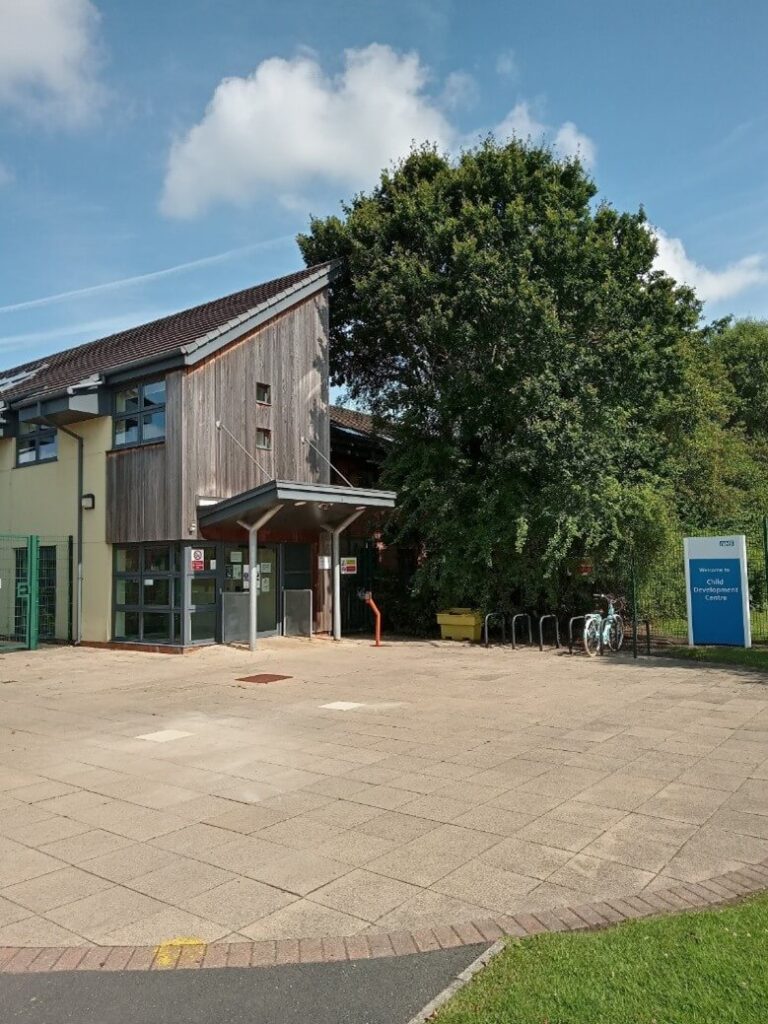
Child Development Centre reception area